
JCIM - JC Information Management

JCIM / OUTCOME SERVICE

From industrial product to market-ready outcome service.

We connect buyer logic, value proposition, field evidence, economics and delivery - before the large solution is built.

Before, technology, roadmaps and early pilots create activity. After, visible evidence governs what is funded, adapted or stopped.

THE EVIDENCE SYSTEM

Six uncertainties. Six management proofs.

  1. 01OPPORTUNITYWhere is the search worthwhile?
  2. 02BUYER & TRIGGERWho acts - and why now?
  3. 03OFFERWhat is concretely buyable?
  4. 04PROOFWhich uncertainty must fall?DECISION GATE
  5. 05OPERATION & ECONOMICSHow will it be delivered reliably?
  6. 06PORTFOLIOWhat is allowed to grow?
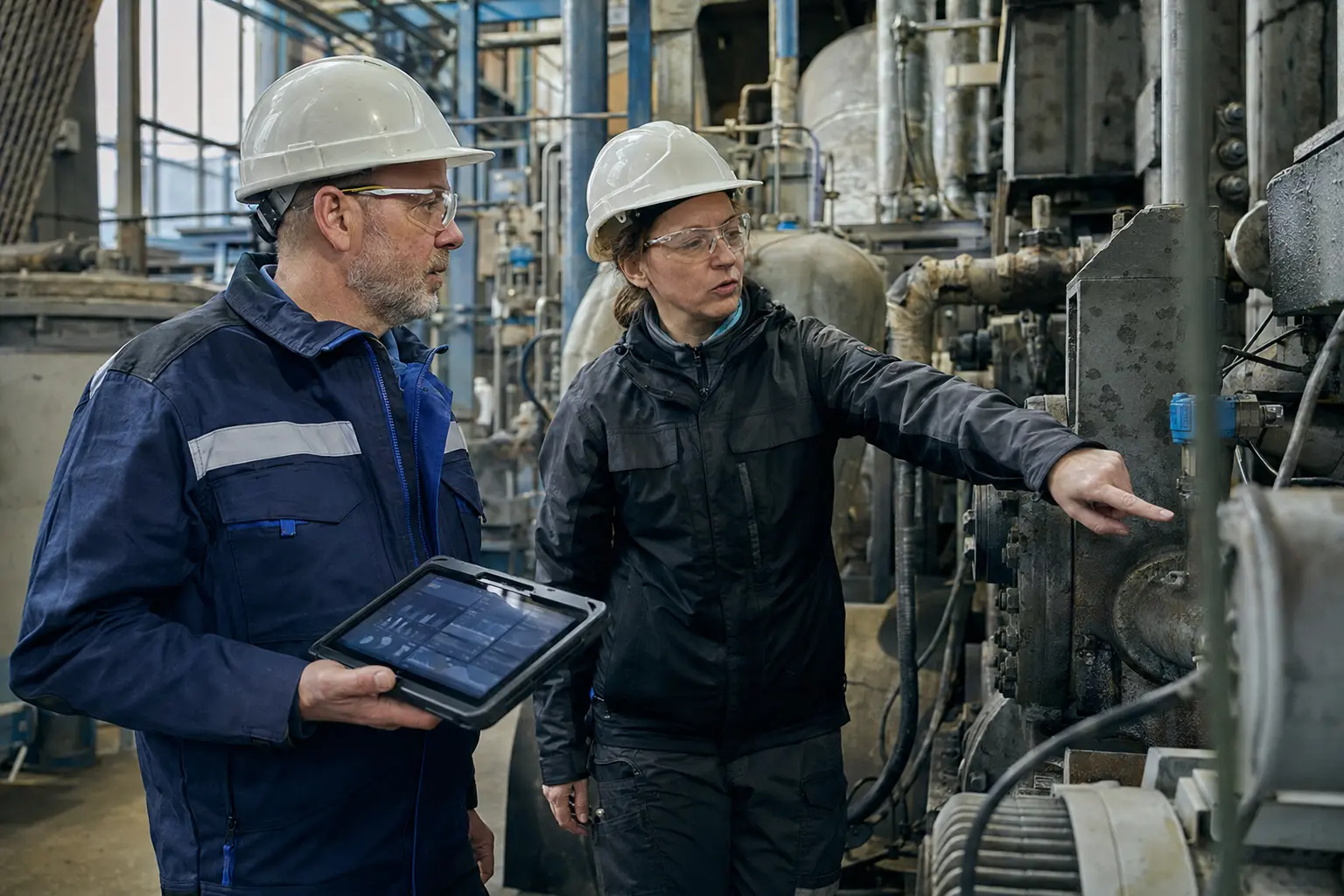
Illustrative field scene - not a representation of a published client engagement.

FIELD NOTE / 01

The technology is real. The service business is not - yet.

We begin in the field: with a recurring situation, an accountable buyer and the smallest proof that enables a real decision.

BEFORE → PATH → AFTER

Illustrative field scene - not a representation of a published client engagement.

BEFORE → PATH → AFTER

Before, activity is created. After, decisions become defensible.

The difference is not more workshops, features or pilots. It is whether every activity closes an open management question and makes the next commitment defensible.

TECHNICAL ACTIVITY

Before

Technical possibilities, internal roadmaps and early pilots set work in motion.
  • Buyer, budget and trigger remain open.
  • The business case is written around the solution.
  • The pilot proves function - not automatically buyability.
  • Economics, delivery and repeatability arrive too late.

The evidence path

  1. 01Search field
  2. 02Buyer / trigger
  3. 03Bounded offer
  4. 04Evidence pilot
  5. 05Operating model / economics
  6. 06Portfolio readiness
Every stage closes a different open claim.

CONTROLLABLE DECISION

After

One continuous evidence system makes the next commitment defensible.
  • Management: visible decision evidence.
  • Sales: a buyable story for a named buyer and trigger.
  • Delivery: explicit scope, roles and handovers.
  • Portfolio: a reasoned Go / Adapt / Stop.

What changes in the work logic

Product logic / Inside-outMarket logic / Outside-in
START

Sensors, data, platforms or features

Buyer, trigger and operating situation

REFERENCE

Internal roadmap

Customer decision

INVESTMENT

Large solution before market proof

Smallest defensible proof

BUSINESS CASE

Written around the solution

Economics and delivery from evidence

Not: What else can we build? Instead: Which observable situation should change for whom - and what small proof is enough?

WHERE ARE YOU TODAY?

Four starting points. Four different first proofs.

Choose the situation closest to your reality. The right next step depends on the largest open uncertainty, not the most attractive technology.

01

Installed base

Current tension

Product, service and field data exist, but are used mainly reactively or case by case.

Open uncertainty

Which recurring customer situation matters enough to support a bounded offer?

Next proof

Test operating situations, roles, current alternatives and observable consequences in the field.

Control artefact

Opportunity Landscape

SERVICE EVIDENCE LADDER

Every stage reduces a different uncertainty.

What remains open early returns later as a technical request, exception, objection or cost-to-serve problem. Select a stage to see which proof must be created there.

01

OPPORTUNITY

Where is the search worthwhile?

Open uncertainty

Which recurring operating situation is economically relevant and influenceable by the OEM?

Artefact

Opportunity Landscape / Service Potential Map

Verification

Prioritised hypotheses and deliberately excluded search fields

Decision enabled

Release one concrete market question - or reject the search field.

The sequence is causal, not a rigid waterfall. New evidence may revise earlier assumptions.

THE ARTEFACT WORLD

Do not claim consulting. Show the decision work.

The artefacts connect assumptions, counter-evidence, ownership and gates across market, technology and operations. No document stands alone.

01Where?

Opportunity Landscape

Open search fields become bounded.

02Who / when?

Buyer & Trigger Map

Role, event and buying criterion become connected.

03What?

Value Proposition System

Value, scope and non-goals become testable.

04Is proof sufficient?

Pilot Evidence Log

Observation, counter-evidence and gate remain visible.

05How to deliver?

Service Blueprint

Core, option, roles and handovers become controllable.

06What grows?

Portfolio Readiness Matrix

Evidence and transfer limits drive Go / Adapt / Stop.

Schematic reconstructions explaining the work logic - no published client data.

No artefact stands alone.

Market evidence changes scope. Scope changes economics and delivery. Delivery changes portfolio and sales story. Every change leaves a visible decision trail.

ANONYMISED ENGAGEMENT PATTERN

One engagement path - from technical initiative to a controllable decision.

This dossier shows a typical work pattern derived from multiple experiences. It does not claim a quantified client outcome.

Industrial specialists jointly inspect equipment and field data
This dossier shows a typical work pattern derived from multiple experiences. It does not claim a quantified client outcome.
  1. 01
    Starting point

    A technical initiative and installed base, but no unambiguous accountable buyer.

  2. 02
    Market question

    Which recurring situation has priority, budget and a concrete trigger?

  3. 03
    Bounded offer

    One value change with explicit scope and customer contribution.

  4. 04
    Field proof

    Baseline, observation, counter-evidence and a pre-agreed decision gate.

  5. 05
    Operating model

    Core performance, options, roles, handovers and economics assumptions.

  6. 06
    Decision

    Go / Adapt / Stop with visible conditions and transfer boundaries.

The proof is not the size of the system built. The proof is the quality of the decision that becomes possible afterwards.

OWNERSHIP

We own the difficult connection. Not your operating reality.

Good collaboration makes the boundary between external leadership and internal ownership explicit.

01

We lead

  • Market and decision logic
  • Offer and pilot architecture
  • Evidence system and convergence
  • Translation into portfolio and delivery
02

Your company brings

  • Product and domain knowledge
  • Access to real customers and fields
  • Accountable decision-makers
  • Operating ownership
03

Decided together

  • Which proof is enough
  • What is deliberately not built
  • When to invest, adapt or stop
  • Which model is repeatable

RISK CONTROL

Stage commitment. Tie exit to evidence.

No artificial urgency and no guarantee theatre. Each larger investment follows only after the named uncertainty has been reduced sufficiently.

01

Potential

Clarify search field and open uncertainty

CHECK
02

Bounded proof

Define hypothesis, baseline and acceptance criteria

PROVE
03

Pilot gate

Evaluate observation and counter-evidence

DECIDE
04

Portfolio gate

Test delivery, economics and transfer

SCALE / STOP

Deferral is not neutral: every roadmap or platform decision made before buyer, trigger and proof are clear binds resources to assumptions that may become harder to reverse.

SIX-QUESTION PREFLIGHT

What is genuinely clear today?

Answer these six questions before the next material service or digital investment. Your selections remain in your browser and are not submitted.

01Which recurring customer problem should concretely change?
02Who owns the problem, budget or decision - and what makes it current?
03Which current alternative must the new offer visibly outperform?
04Which single uncertainty must the smallest pilot reduce?
05Which product, data, customer and operating contributions must your company provide?
06Which evidence would authorise Invest, Adapt or Stop?

QUESTIONS & BOUNDARIES

Clarity before commitment.

01Does the approach only work for digital services?

No. It applies to technical, data-based and hybrid services when the customer problem, deliverable performance and testable proof can be defined.

02Do we need JCIM if we already have an innovation or digital team?

Not necessarily. The internal route is legitimate. We become relevant when market logic, pilot proof, economics, operating model and portfolio need to form one coherent decision system.

03What does a project cost?

We price only after goal, scope, contributions, evidence need and delivery model are clear. Anything earlier would be invented.

04Which results can you guarantee?

We do not guarantee market, revenue or operating outcomes. We can deliver decision logic, artefacts, pilot architecture and operating translation. Market response and technical reality remain to be proven.

05What happens after the Potential Check?

Only if a meaningful opportunity and named evidence need are visible do we describe a bounded next step. Otherwise, it remains our assessment.

THE CONCRETE NEXT STEP

Which single uncertainty should fall first?

In a 30-minute Service Potential Check, we assess whether your product, installed base or digital initiative can support a meaningful service path. No pitch deck is required.

Assess service potentialNo obligation to proceed. Scope, contributions, evidence gates and commercial terms are agreed transparently only afterwards.